General Science and Ability CSS Course 2026
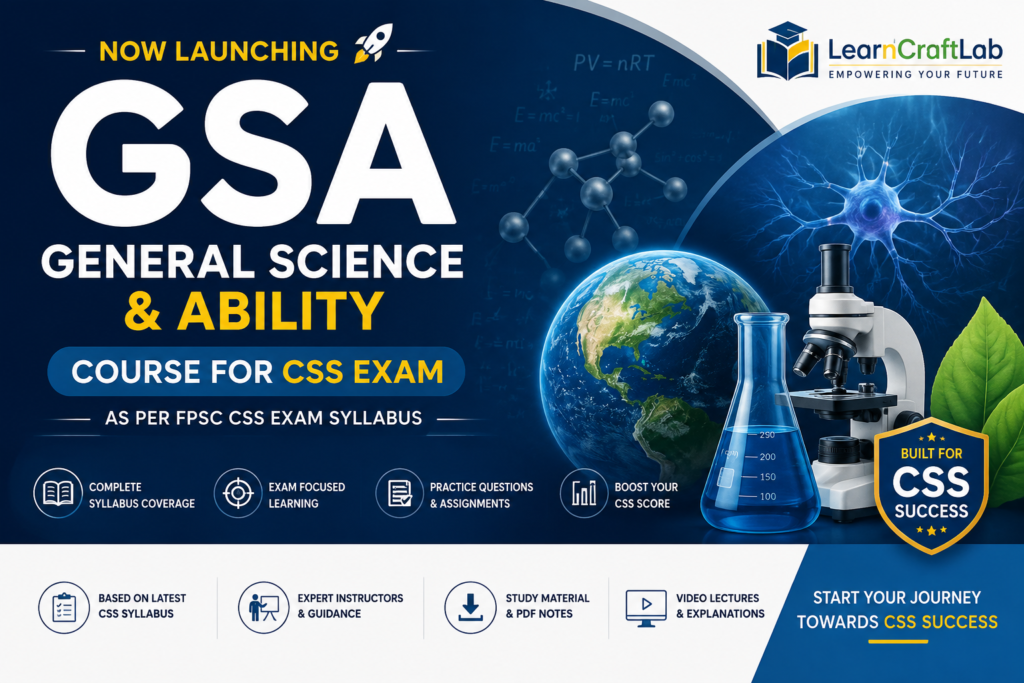
General Science and Ability CSS Course
The General Science and Ability course by LearnCraftLab is a comprehensive CSS exam preparation course designed according to the official FPSC CSS syllabus. The course covers both major components of the paper: General Science and General Ability.
This GSA CSS preparation course helps aspirants build strong scientific concepts, improve quantitative and analytical reasoning skills, understand everyday science and technology, and develop the problem-solving abilities required for effective CSS Exam Preparation.
Course at a Glance
📚 Course Contents
Part I: General Science — 60 Marks
Complete coverage of the major scientific areas included in the CSS syllabus.
🔭 Physical Sciences
This section develops your understanding of important concepts from physics, chemistry, astronomy, earth science and energy.
- ✓Universe and its constituents
- ✓Galaxy and Solar System
- ✓Light Year
- ✓Sun and Earth
- ✓Astronomical System of Units
- ✓Rotation and Revolution of Earth
- ✓Solar and Lunar Eclipses
- ✓Weather variables
- ✓Global temperature and atmospheric pressure
- ✓Atmospheric circulation
- ✓Precipitation and humidity
- ✓Weather variations
- ✓Earthquakes
- ✓Volcanic eruptions
- ✓Tsunamis
- ✓Floods and avalanches
- ✓Tropical cyclones
- ✓Middle-latitude cyclones
- ✓Tornadoes
- ✓Droughts
- ✓Wildfires and urban fires
- ✓Disaster Risk Management
- ✓Renewable and non-renewable energy
- ✓Solar and wind energy
- ✓Energy conservation
- ✓Atomic structure
- ✓Chemical bonding
- ✓Electromagnetic radiations
- ✓Ceramics and plastics
- ✓Semiconductors
- ✓Antibiotics and vaccines
- ✓Fertilizers and pesticides
🧬 Biological Sciences
Learn the fundamental concepts of life sciences, human biology, diseases, nutrition-related biology and modern biological applications.
- ✓Cell structure and functions
- ✓Nucleus, mitochondria and ribosomes
- ✓Basic concepts of life
- ✓Proteins
- ✓Lipids
- ✓Carbohydrates
- ✓Enzymes
- ✓Plant Kingdom
- ✓Animal Kingdom
- ✓Similarities and diversity in plants and animals
- ✓Human physiology
- ✓Common diseases and epidemics
- ✓Polio
- ✓Diarrhea
- ✓Malaria
- ✓Hepatitis
- ✓Dengue
- ✓Causes and prevention of common diseases
- ✓Biofuel
- ✓Modern methods of biofuel production
🌍 Environmental Science
Understand the major environmental systems, pollution, climate-related issues, natural resources and environmental management.
- ✓Atmosphere and its layered structure
- ✓Composition of the atmosphere
- ✓Hydrosphere
- ✓Water cycle
- ✓Major water compartments
- ✓Biosphere and major biomes
- ✓Lithosphere
- ✓Minerals and rocks
- ✓Types of rocks
- ✓Plate tectonics
- ✓Atmospheric pollution
- ✓Major air pollutants
- ✓COx, particulate matter, NOx and SOx
- ✓Tropospheric ozone
- ✓Volatile Organic Compounds
- ✓Dioxins
- ✓Acid rain
- ✓Ozone depletion
- ✓Greenhouse effect
- ✓Global warming
- ✓Montreal Protocol
- ✓Kyoto Protocol
- ✓Water pollution
- ✓Water pollutants and their effects
- ✓Drinking water quality
- ✓Land pollution
- ✓Solid waste management
- ✓Remote Sensing and GIS
- ✓Population planning
🍎 Food Science
Understand nutrition, food quality, food deterioration, adulteration and preservation.
- ✓Balanced diet
- ✓Vitamins
- ✓Carbohydrates
- ✓Proteins
- ✓Fats and oils
- ✓Minerals
- ✓Dietary fiber
- ✓Bioavailability of nutrients
- ✓Food appearance
- ✓Food texture
- ✓Food flavor
- ✓Packed food quality
- ✓Frozen food quality
- ✓Food additives
- ✓Preservatives
- ✓Antioxidants
- ✓Food deterioration
- ✓Food adulteration
- ✓Food preservation
💻 Information Technology
Learn the fundamentals of computing, networking, internet technologies, telecommunications and emerging technologies.
- ✓Computer hardware
- ✓Computer software
- ✓Input and output processing
- ✓Data storage
- ✓Computer networking
- ✓Internet standards
- ✓Application software
- ✓Business software
- ✓Social media websites
- ✓Information systems
- ✓Fundamentals of Artificial Intelligence
- ✓Wireless communication
- ✓Mobile communication
- ✓Satellite communication
- ✓Surveillance technology
- ✓GPS
- ✓Fiber-optic communication
Part II: General Ability — 40 Marks
Develop the quantitative, logical, analytical and mental abilities required for the CSS examination.
➗ Quantitative Ability & Reasoning
Strengthen mathematical foundations and learn to solve quantitative problems efficiently and accurately.
- ✓Basic mathematical skills
- ✓Quantitative reasoning
- ✓Problem-solving techniques
- ✓Basic arithmetic
- ✓Averages
- ✓Ratios
- ✓Rates
- ✓Percentages
- ✓Basic algebra
- ✓Equations
- ✓Geometry
- ✓Angles
- ✓Triangles
- ✓Sets
- ✓Remainders
- ✓Symbols
- ✓Rounding of numbers
- ✓Random sampling
🧩 Logical & Analytical Reasoning
Improve your ability to analyze information, identify relationships, solve problems and reach logical conclusions.
- ✓Logical reasoning
- ✓Systematic problem solving
- ✓Reasoning from given statements
- ✓Drawing logical conclusions
- ✓Analytical reasoning
- ✓Information analysis
- ✓Problem visualization
- ✓Decision-making
- ✓Logical thinking
- ✓Complex problem solving
🧠 Mental Abilities
Develop the different mental abilities required for reasoning and problem-solving in competitive examinations.
- ✓Verbal ability
- ✓Mechanical ability
- ✓Numerical ability
- ✓Social ability
- ✓Mental ability practice
- ✓Reasoning-based exercises
- ✓Exam-oriented problem solving
What Is Included in This GSA CSS Course?
Video Lectures
Structured lessons explaining important concepts in a clear and understandable way.
Study Materials
Topic-wise learning resources for understanding and revising important concepts.
Practice Questions
Practice questions to reinforce scientific, quantitative and reasoning concepts.
Reasoning Practice
Quantitative, logical, analytical and mental ability exercises.
Exam-Oriented Learning
Preparation focused on understanding and applying concepts in competitive examinations.
Revision Support
Revision-focused learning to help retain important concepts before the examination.
What Will You Learn After Completing This Course?
After completing this course, you will have a structured understanding of the major scientific and analytical areas covered in the CSS GSA syllabus and a stronger ability to approach scientific, quantitative and reasoning-based questions.
- ✓
Understand fundamental scientific concepts. - ✓
Connect scientific concepts with everyday life. - ✓
Understand important physical and biological processes. - ✓
Analyze environmental and technological issues. - ✓
Understand basic information technology and telecommunications. - ✓
Solve quantitative problems more efficiently. - ✓
Apply logical and analytical reasoning. - ✓
Improve numerical, verbal and mental abilities. - ✓
Approach CSS GSA questions with greater confidence. - ✓
Build a strong foundation for CSS Exam Preparation.
Who Should Enroll in This Course?
This course is suitable for aspirants who want a structured and comprehensive approach to their CSS GSA preparation.
- ✓
CSS aspirants preparing for the compulsory GSA paper. - ✓
Students who find General Science difficult or confusing. - ✓
Aspirants who need a structured preparation plan. - ✓
Students who want to strengthen quantitative and analytical reasoning. - ✓
Candidates looking for topic-wise science preparation. - ✓
Beginners who want to build their concepts from the fundamentals. - ✓
CSS candidates looking for organized online learning resources.
Complete General Science and Ability Syllabus Coverage
A structured overview of the major areas covered in the CSS General Science and Ability paper.
| Section | Major Areas | Marks |
|---|---|---|
| Physical Sciences | Universe, Earth, weather, natural disasters, energy resources, atomic structure, chemical bonding, electromagnetic radiation, materials, semiconductors, antibiotics, vaccines, fertilizers and pesticides. | 60 |
| Biological Sciences | Cells, biomolecules, plants, animals, human physiology, diseases, epidemics and biofuel. | |
| Environmental Science | Atmosphere, hydrosphere, biosphere, lithosphere, pollution, acid rain, ozone depletion, greenhouse effect, global warming, water pollution, waste management, GIS and population planning. | |
| Food Science | Balanced diet, vitamins, carbohydrates, proteins, fats, minerals, dietary fiber, food quality, additives, preservatives, deterioration, adulteration and preservation. | |
| Information Technology | Computer hardware and software, networking, internet standards, information systems, artificial intelligence, wireless communication, mobile communication, satellites, GPS and fiber optics. | |
| Quantitative Ability | Arithmetic, averages, ratios, rates, percentages, algebra, equations, geometry, sets, remainders, symbols, rounding and random sampling. | 40 |
| Logical & Analytical Reasoning | Logical thinking, systematic problem solving, information analysis, conclusions, decision-making, visualization and analytical reasoning. | |
| Mental Abilities | Verbal, mechanical, numerical and social abilities along with reasoning-based and exam-oriented mental ability practice. |
Our Approach to CSS GSA Preparation
Learn
Understand the fundamental concept before moving toward application and practice.
Understand
Connect concepts with examples, applications and everyday scientific situations.
Practice
Solve questions to strengthen scientific, quantitative and reasoning abilities.
Revise
Review important concepts and prepare strategically for the examination.
Frequently Asked Questions
What is General Science and Ability in CSS?
What topics are included in General Science?
What topics are included in General Ability?
Is this course suitable for beginners?
Does this course cover CSS GSA preparation?
Build Your GSA Foundation for CSS
Strengthen your scientific knowledge, quantitative ability and reasoning skills with a structured General Science and Ability course designed for CSS aspirants.
Curriculum
- 2 Sections
- 12 Lessons
- Lifetime
- General Science & Ability Complete Course 20261 Item
- Chapter 1: The Universe and Its Structure11 Items
Instructor