
General Science and Ability CSS Course 2026 2 Sections12 LessonsLifetime
1.8 Nebulae
🌌 Introduction to Nebulae
Space is not completely empty. Between stars there are enormous regions
containing extremely thin clouds of gas and cosmic dust.
These clouds are known as nebulae (singular:
nebula).
Nebulae are important because they are associated with both the
birth and death of stars. Some nebulae are regions where
new stars are forming, while others are created from material expelled
by dying stars.
In simple terms, a nebula can be thought of as a vast cosmic cloud
containing material from which stars may form or material left behind
by stellar evolution.
⭐ What Is a Nebula?
A nebula is a large cloud of gas and dust located
between stars or around stars.
The gas in nebulae consists mainly of hydrogen and helium,
along with heavier elements and microscopic dust particles.
🔬 What Are Nebulae Made Of?
Hydrogen
Hydrogen is the most abundant element in many nebular clouds and is
an important raw material for star formation.
Helium
Helium is another major component of interstellar gas and is also
important in the life cycle of stars.
Cosmic Dust
Tiny solid particles mixed with gas can absorb, scatter and reflect
light, producing many of the structures observed in nebulae.
⭐ Nebulae and the Birth of Stars
Some nebulae are active star-forming regions. Gravity
can cause parts of a cloud of gas and dust to become denser and collapse.
As the material gathers, the central region becomes increasingly hot and
dense.
Eventually, this collapsing material can form a protostar.
If the conditions become suitable for sustained nuclear fusion, a new
star is formed.
🔄 How a Star Can Form From a Nebula
1. Gas & Dust
A large cloud exists in space.
2. Gravity
Dense regions begin collapsing.
3. Protostar
Material gathers around a hot central core.
4. Star
Nuclear fusion begins in the core.
🌠 Major Types of Nebulae
Astronomers classify nebulae according to how they interact with light
and how they are formed. Four important categories for CSS GSA are
emission nebulae, reflection nebulae, planetary nebulae,
and supernova remnants.
| Type | Main Characteristic | Example |
|---|---|---|
| Emission Nebula | Emits its own light after its gas is energized or ionized by nearby stars. |
Orion Nebula |
| Reflection Nebula | Reflects and scatters light from nearby stars. | NGC 1999 |
| Planetary Nebula | Expanding gas expelled by a dying Sun-like or medium-sized star. | Helix Nebula |
| Supernova Remnant | Gas and material left behind after a massive stellar explosion. | Crab Nebula |
🔴 1. Emission Nebulae
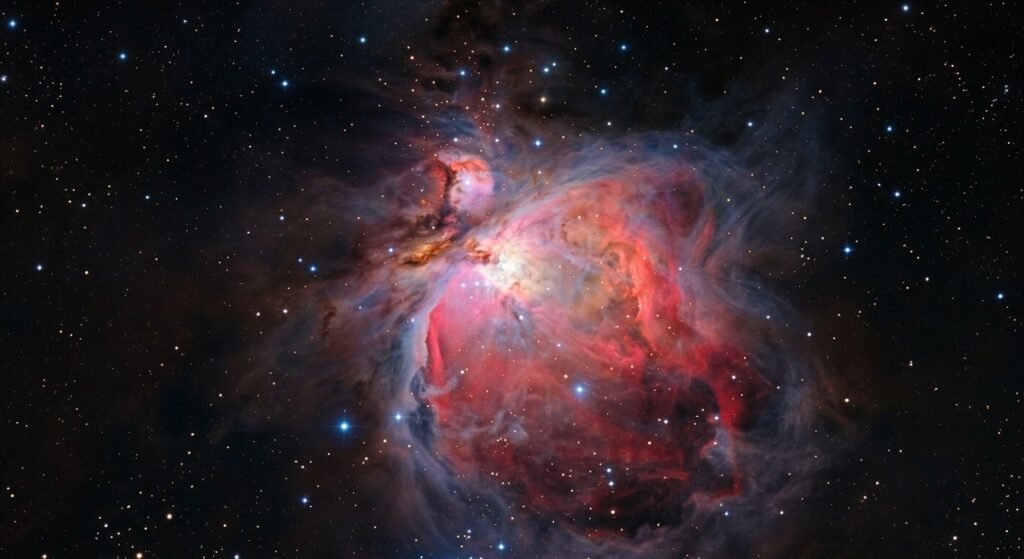
Emission nebulae emit their own light. Radiation from
nearby hot stars can energize the gas in the nebula. When the energized
gas returns to lower-energy states, it releases light.
Many emission nebulae are associated with regions where young stars are
forming. The Orion Nebula is a famous example.
🔵 2. Reflection Nebulae
Reflection nebulae do not primarily produce their own
visible light. Instead, dust within the nebula scatters and reflects
light from nearby stars.
Because shorter blue wavelengths are scattered efficiently by small dust
particles, reflection nebulae often appear bluish in
visible-light images.
🟣 3. Planetary Nebulae
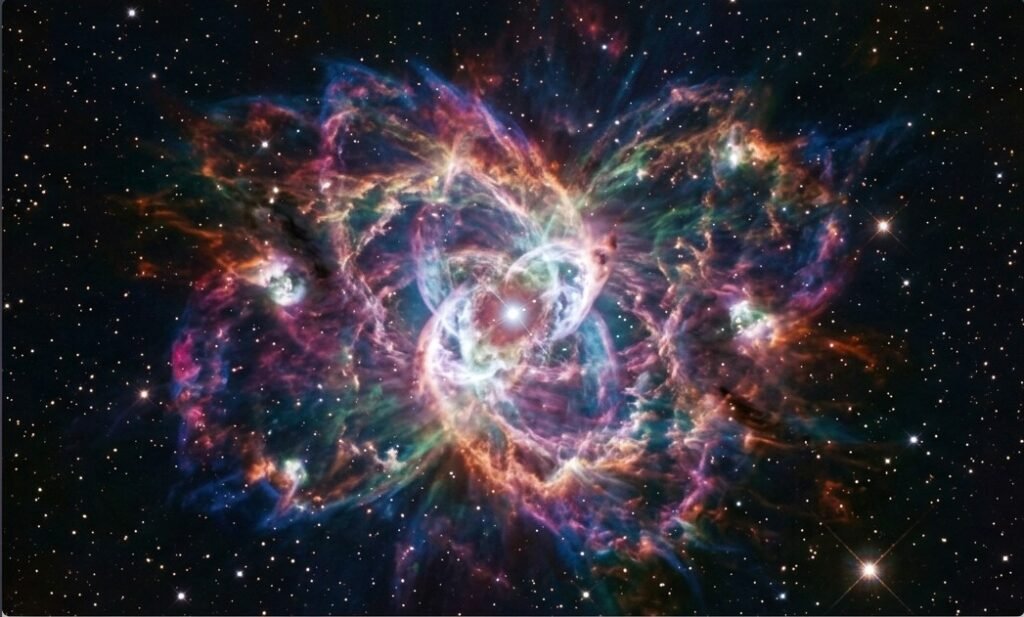
A planetary nebula forms during a late stage in the
life of a Sun-like or medium-sized star. The star expels much of its
outer material, creating an expanding shell of gas around the remaining
hot stellar core.
Despite the name, a planetary nebula has nothing to do with
planets. Early astronomers gave these objects the name because
some of them appeared round and planet-like through early telescopes.
💥 4. Supernova Remnants
When certain massive stars end their lives in powerful explosions called
supernovae, enormous amounts of gas and other material
are expelled into space.
The expanding material can form a supernova remnant.
The Crab Nebula is a famous example of a supernova
remnant.
📌 Important: Nebula vs Galaxy
A nebula and a galaxy are not the same thing.
| Nebula | Galaxy |
|---|---|
| Cloud of gas and dust | Vast gravitationally bound system |
| Can be a star-forming region or stellar remnant | Contains stars, gas, dust, dark matter and other structures |
⚠️ Common CSS Exam Confusion
Planetary nebulae are not planets.
The name is historical. A planetary nebula is actually material expelled
by a dying star, illuminated by the hot stellar remnant at its center.
🎯 Important CSS GSA Facts
- A nebula is a large cloud of gas and dust in space.
- Nebulae are found in interstellar space and can also surround stars.
- Hydrogen and helium are major components of nebular gas.
- Some nebulae are important star-forming regions.
- Emission nebulae emit their own light.
- Reflection nebulae scatter and reflect light from nearby stars.
- Planetary nebulae are associated with the late evolution of Sun-like stars.
- A supernova remnant can result from a powerful stellar explosion.
- The Orion Nebula is a famous star-forming region.
- The Crab Nebula is a famous supernova remnant.
- The term “planetary nebula” is a historical name and does not mean that planets are involved.
⚡ Quick Revision
Nebula
Cloud of gas and dust
Emission
Produces its own light
Reflection
Reflects/scatters starlight
Planetary
Late stage of Sun-like stars
Supernova Remnant
Material from stellar explosion
Star Nursery
Star-forming nebular region
📝 CSS-Style Practice MCQs
1. A nebula is primarily a:
A. Group of planets
B. Cloud of gas and dust
C. Type of galaxy
D. Black hole
2. Which type of nebula emits its own light?
A. Reflection nebula
B. Emission nebula
C. Dark nebula
D. Molecular cloud
3. Which nebula type is associated with the late stage of a Sun-like star?
A. Planetary nebula
B. Reflection nebula
C. Emission nebula
D. Dark nebula
4. The Orion Nebula is particularly important because it is:
A. A galaxy
B. A star-forming region
C. A black hole
D. A planet
5. The Crab Nebula is an example of a:
A. Reflection nebula
B. Planetary nebula
C. Supernova remnant
D. Galaxy
🌌 Key Takeaway
Nebulae are vast clouds of gas and dust that play an important role in
the life cycle of stars. Some provide the material and environment for
new stars to form, while others are created from material expelled by
dying stars. For CSS GSA, remember their composition, role in star
formation, major types, and the difference between emission, reflection,
planetary and supernova-remnant nebulae.