
General Science and Ability CSS Course 2026 2 Sections12 LessonsLifetime
1.10 Astronomical Units
☀️ Introduction to the Astronomical Unit
The Solar System is enormous. Even the distances between the Sun and the
planets are far too large to describe conveniently using everyday units.
For example, the average distance between Earth and the Sun is about
150 million kilometres.
To make distances within planetary systems easier to express, astronomers
use a special unit called the astronomical unit, commonly
abbreviated as AU in educational contexts.
🌍 What Is an Astronomical Unit?
The astronomical unit is a unit of length used mainly to
describe distances within the Solar System and other planetary systems.
It is defined exactly as:
1 au = 149,597,870.7 km
Approximately 149.6 million kilometres
This value is approximately the average distance between the
Earth and the Sun.
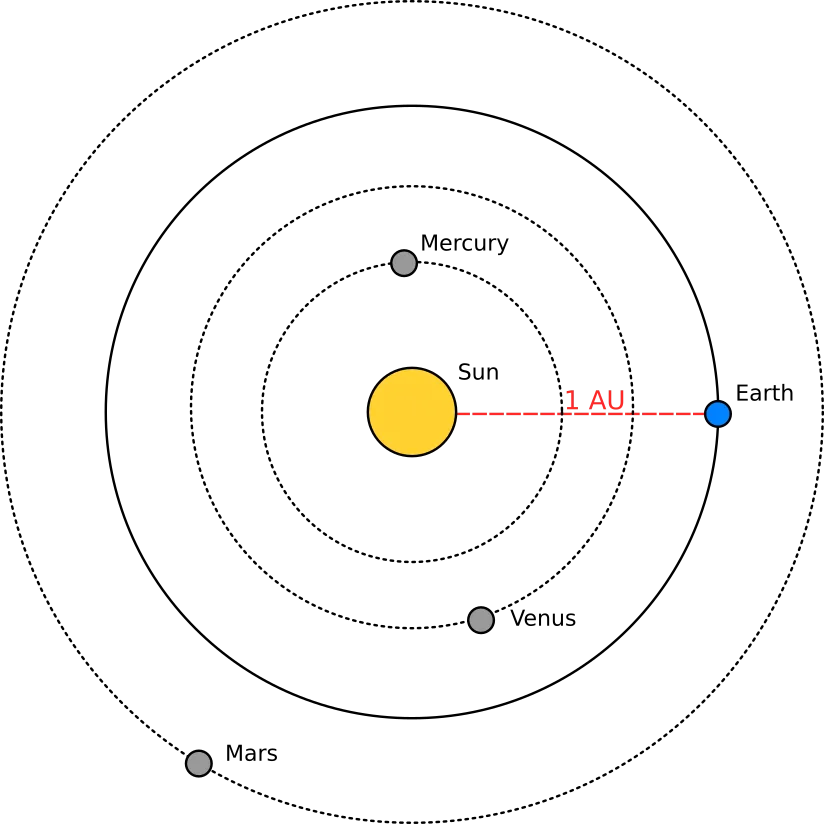
The astronomical unit provides a convenient scale for describing distances
within the Solar System.
📏 The Basic Idea
Earth–Sun Distance ≈ 1 Astronomical Unit
The astronomical unit provides a convenient reference scale for measuring
distances throughout the Solar System.
🔭 Why Do Astronomers Use AU?
Planetary distances are extremely large when expressed in kilometres.
Using astronomical units makes these distances much easier to compare.
Kilometres
Very large numbers for planetary distances
Astronomical Units
Smaller and easier numerical values
🪐 Distances of Planets in Astronomical Units
The approximate average distances of the planets from the Sun can be
expressed in astronomical units. Earth provides the reference point at
approximately 1 au.
| Planet | Approx. Distance from Sun | Approx. Distance in AU |
|---|---|---|
| Mercury | 57.9 million km | 0.39 au |
| Venus | 108.2 million km | 0.72 au |
| Earth | 149.6 million km | 1.00 au |
| Mars | 227.9 million km | 1.52 au |
| Jupiter | 778.5 million km | 5.20 au |
| Saturn | 1.43 billion km | 9.54 au |
| Uranus | 2.87 billion km | 19.2 au |
| Neptune | 4.50 billion km | 30.1 au |
🌍 Earth and the Sun: 1 au
Earth orbits the Sun at an average distance of approximately
149.6 million kilometres.
This distance corresponds approximately to 1 au.
However, Earth’s orbit is not a perfect circle, so the actual Earth–Sun
distance changes during the year. The astronomical unit itself is now
defined as an exact length rather than as a changing measured distance.
🌠 Astronomical Unit vs Light-Year
Both the astronomical unit and the light-year are units of distance,
but they are useful at different scales.
| Feature | Astronomical Unit | Light-Year |
|---|---|---|
| Type | Unit of distance | Unit of distance |
| Reference | Earth–Sun distance | Distance light travels in one year |
| Approx. Size | 149.6 million km | 9.46 trillion km |
| Main Use | Solar System distances | Interstellar and larger distances |
🔬 Astronomical Unit vs Parsec
A parsec is another astronomical unit of distance.
It is commonly used in professional astronomy for very large distances.
1 au
149,597,870.7 km
1 Light-Year
≈ 63,240 au
1 Parsec
≈ 206,265 au
💡 How Long Does Light Take to Travel 1 au?
Light travels extremely quickly. Nevertheless, it takes a measurable amount
of time to travel across the Earth–Sun distance.
1 au ≈ 8.3 light-minutes
Sunlight takes about 8 minutes 20 seconds to reach Earth.
🎯 Important CSS GSA Facts
- The astronomical unit is a unit of length used mainly
for distances within the Solar System. - The astronomical unit is exactly
149,597,870.7 km. - It is approximately the average distance between the
Earth and the Sun. - 1 au ≈ 149.6 million km.
- Earth’s average orbital distance from the Sun is approximately
1 au. - The astronomical unit is especially useful for comparing planetary
distances. - 1 light-year ≈ 63,240 au.
- Light takes approximately 8.3 minutes to travel
from the Sun to Earth. - The astronomical unit is much smaller than a light-year.
⚡ Quick Revision
Astronomical Unit
Unit of astronomical distance
1 au
149,597,870.7 km
Earth–Sun
≈ 1 au
1 Light-Year
≈ 63,240 au
Sunlight
≈ 8.3 minutes to Earth
Main Use
Distances within planetary systems
📝 CSS-Style Practice MCQs
1. An astronomical unit is primarily used to measure:
A. Temperature of stars
B. Distances within the Solar System
C. Mass of planets
D. Age of galaxies
2. One astronomical unit is exactly equal to approximately:
A. 1.496 million km
B. 14.96 million km
C. 149.6 million km
D. 1.496 trillion km
3. One astronomical unit is approximately the distance between:
A. Earth and Moon
B. Earth and Mars
C. Earth and Sun
D. Sun and Jupiter
4. Approximately how many astronomical units are in one light-year?
A. 63.24 au
B. 632.4 au
C. 6,324 au
D. 63,240 au
5. Approximately how long does sunlight take to travel from the Sun to Earth?
A. 8.3 seconds
B. 8.3 minutes
C. 8.3 hours
D. 8.3 days
🌌 Key Takeaway
The astronomical unit is a standard unit of distance used mainly for
measuring distances within the Solar System. It is defined as exactly
149,597,870.7 kilometres, approximately the average
Earth–Sun distance. For CSS GSA, remember that
1 au ≈ 149.6 million km, Earth is approximately
1 au from the Sun, and a light-year is approximately
63,240 au.