
General Science and Ability CSS Course 2026 2 Sections12 LessonsLifetime
1.7 Constellations
🌌 Introduction to Constellations
When we look at the night sky, many stars appear to form recognizable
patterns. Humans have observed these patterns for thousands of years
and have given them names based on mythology, animals, objects and
other figures.
These recognized patterns and regions of the sky are called
constellations. They help astronomers and observers
identify and locate objects in the night sky.
⭐ What Is a Constellation?
A constellation is a recognized pattern or region of
stars in the sky as viewed from Earth.
The stars that appear to form a constellation are generally not
physically close to one another. They may be separated by enormous
distances in space but appear to form a pattern from our viewpoint.
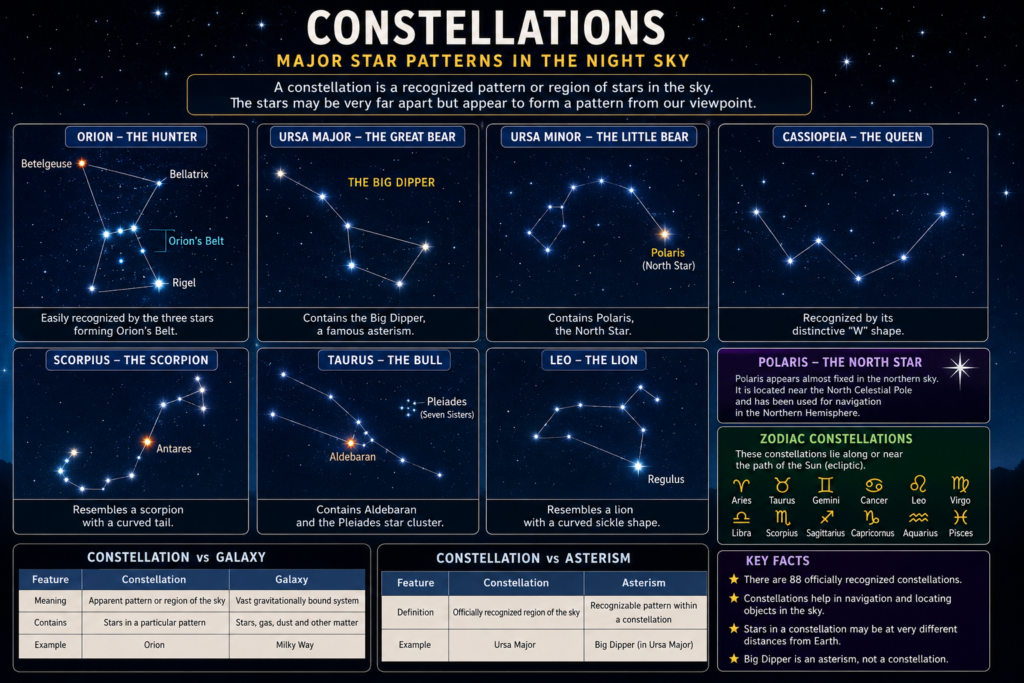
Major constellations and recognizable patterns of stars in the night sky.
📌 Important Concept
A constellation is an apparent pattern of stars.
The stars do not necessarily belong to the same physical system or
lie at the same distance from Earth.
🌟 Major Constellations
There are 88 officially recognized constellations
covering the entire sky. Some are particularly well known because
they are easy to recognize or have historical and navigational
importance.
🏹 Orion
Known as the Hunter and easily recognized by the three bright
stars forming Orion’s Belt.
🐻 Ursa Major
Known as the Great Bear. It contains the prominent Big Dipper
star pattern.
🐻 Ursa Minor
The Little Bear constellation containing Polaris, the
well-known North Star.
👑 Cassiopeia
A northern constellation commonly recognized by its distinctive
W or M-shaped arrangement of bright stars.
🦂 Scorpius
A prominent constellation whose stars form a pattern resembling
a scorpion.
🏹 Orion — The Hunter
Orion is one of the most recognizable constellations in the night sky.
It is especially easy to identify because of the three bright stars
that form Orion’s Belt.
Orion contains several notable stars, including
Betelgeuse and
Rigel.
🐻 Ursa Major and the Big Dipper
Ursa Major, meaning “Great Bear,” is a prominent
constellation in the northern sky.
A famous star pattern within Ursa Major is the
Big Dipper. The Big Dipper is an
asterism, not a separate constellation.
📌 CSS Exam Point
Big Dipper = Asterism
Ursa Major = Constellation
🐻 Ursa Minor and Polaris
Ursa Minor, or the Little Bear, is another important
northern constellation.
It is especially famous because it contains
Polaris, commonly called the
North Star or Pole Star.
⭐ Polaris — The North Star
Polaris is located very close to the direction of the
North Celestial Pole. As a result, it appears to
remain nearly fixed in the northern sky while other stars appear to
move around it during the night.
Because of this, Polaris has historically been useful for
navigation in the Northern Hemisphere.
🧭 Constellations and Navigation
Before modern navigation technology, people used the positions of
stars and recognizable constellations to help determine direction
and navigate across land and oceans.
In the Northern Hemisphere, locating Polaris provides
a useful indication of the direction of north.
♈ Zodiac Constellations
The zodiac constellations are constellations located
along or near the apparent path of the Sun across the sky, known as
the ecliptic.
Examples include Aries, Taurus, Gemini, Leo, Virgo, Libra,
Scorpius, Sagittarius and others.
Astronomy and astrology use the term “zodiac” differently. For CSS
General Science and Ability, the important concept is the astronomical
position of these constellations relative to the ecliptic.
🔭 Constellation vs Galaxy
| Feature | Constellation | Galaxy |
|---|---|---|
| Meaning | Apparent pattern or region of the sky | Vast gravitationally bound system |
| Contains | Stars appearing in a particular pattern | Stars, gas, dust and other matter |
| Example | Orion | Milky Way |
✨ Constellation vs Asterism
An asterism is a recognizable pattern of stars that
is not necessarily an officially recognized constellation.
For example, the Big Dipper is an asterism within
the constellation Ursa Major.
🎯 Important CSS GSA Facts
- There are 88 officially recognized constellations.
- A constellation is an apparent pattern or region of the sky.
- The stars in a constellation may be at very different distances from Earth.
- Orion is commonly known as the Hunter.
- Orion’s Belt consists of three prominent stars.
- Ursa Major is known as the Great Bear.
- The Big Dipper is an asterism within Ursa Major.
- Ursa Minor contains Polaris.
- Polaris is commonly known as the North Star.
- Polaris has historically been useful for navigation in the Northern Hemisphere.
- Zodiac constellations lie along or near the ecliptic.
⚡ Quick Revision
88
Orion
Ursa Major
Ursa Minor
Polaris
Big Dipper
📝 CSS-Style Practice MCQs
1. How many constellations are officially recognized?
A. 48
B. 72
C. 88
D. 108
2. Which constellation is known as the Hunter?
A. Orion
B. Leo
C. Taurus
D. Cassiopeia
3. Polaris is commonly known as the:
A. Southern Star
B. North Star
C. Evening Star
D. Morning Star
4. The Big Dipper is:
A. A galaxy
B. A planet
C. An asterism
D. A nebula
5. Polaris is located in which constellation?
A. Ursa Major
B. Orion
C. Ursa Minor
D. Scorpius
🌌 Key Takeaway
Constellations are recognizable patterns or regions of the night sky.
They have helped people identify stars, understand the sky and navigate
for thousands of years. For CSS GSA, remember the major constellations,
Polaris, the Big Dipper, zodiac constellations and the difference
between a constellation and an asterism.
1.7 Constellations
A concise, exam-focused lesson for General Science and Ability
CSS preparation.