1.6 Stars and Their Life Cycle
⭐ Introduction to Stars
Stars are among the most important objects in the Universe. They are
enormous, extremely hot spheres of gas held together by their own
gravity.
The Sun is the closest star to Earth and is the primary source of
energy for life on our planet. Like other stars, the Sun was formed
from a cloud of gas and dust and will eventually undergo changes as
it progresses through its stellar life cycle.
A star does not remain unchanged throughout its existence. It is born,
evolves over millions or billions of years, and eventually reaches
an end determined largely by its mass.
🎯 Learning Objectives
After completing this lesson, you should be able to:
- Define a star and explain its basic composition.
- Understand how stars are formed.
- Explain the role of nebulae in star formation.
- Understand the protostar stage.
- Explain the main sequence stage.
- Understand nuclear fusion inside stars.
- Explain how stellar mass affects a star’s evolution.
- Understand the formation of red giants and red supergiants.
- Explain the formation of white dwarfs, neutron stars and black holes.
- Understand the complete life cycle of a star.
1.6.1 What Is a Star?
A star is a massive astronomical object composed
primarily of extremely hot gas or plasma and held together by gravity.
Stars generate enormous amounts of energy. During most of their active
lifetime, this energy is produced through nuclear fusion
occurring in their cores.
📌 CSS Key Definition
A star is a massive, self-gravitating astronomical object
that produces energy, primarily through nuclear fusion in its core.
1.6.2 What Are Stars Made Of?
Stars are composed mainly of hydrogen and helium.
Smaller quantities of heavier elements are also present.
💧 Hydrogen
The most abundant element in ordinary stars and the main fuel
for hydrogen fusion during the main-sequence stage.
🎈 Helium
Produced when hydrogen nuclei fuse together in the cores of
stars.
🧪 Heavy Elements
Stars also contain smaller amounts of elements heavier than
helium.
1.6.3 How Are Stars Born?
Stars begin their lives in enormous clouds of gas and dust known as
nebulae. These clouds contain material that can
eventually collapse under the influence of gravity.
When part of a nebula becomes sufficiently dense, gravity pulls the
material together. As the material contracts, its temperature and
pressure increase, eventually leading to the formation of a
protostar.
🌟 Birth of a Star
Nebula
Gas and dust cloud
Protostar
Collapsing young star
Main Sequence
Stable fusion stage
1.6.4 Nebula — The Stellar Nursery
A nebula is a large cloud of gas and dust in space.
Some nebulae serve as regions where new stars can form.
Under suitable conditions, gravity causes parts of these clouds to
collapse. The material becomes increasingly concentrated and forms
young stellar objects.
Remember:
A star-forming nebula is often called a
stellar nursery.
1.6.5 Protostar
A protostar is an early stage in the development of
a star. It forms when material from a collapsing molecular cloud
becomes concentrated under gravity.
During this stage, gravitational contraction causes the temperature
inside the developing object to increase.
Once the core becomes sufficiently hot and dense for sustained
hydrogen fusion, the object can enter the main-sequence stage.
1.6.6 Main Sequence Stars
The main sequence is the longest and most stable
stage in the life of most stars.
During this stage, stars convert hydrogen into helium in their cores
through nuclear fusion. The energy released by this process provides
the energy that makes stars shine.
⭐ Main Sequence = Stable Hydrogen Fusion
The star’s inward gravitational force is balanced by the outward
pressure associated with the energy produced in its interior.
1.6.7 Nuclear Fusion in Stars
Nuclear fusion is the process in which light atomic
nuclei combine to form heavier nuclei while releasing energy.
In stars like the Sun, hydrogen nuclei ultimately combine to produce
helium. A small amount of mass is converted into energy during the
process.
1.6.8 Why Does a Star Shine?
Stars shine because energy generated in their interiors travels
outward and is eventually radiated into space.
The enormous energy produced by nuclear fusion is responsible for the
light and heat emitted by stars during their active stages.💡 Simple Concept
Nuclear fusion → Energy → Light and heat from the star
1.6.9 The Importance of Stellar Mass
One of the most important factors controlling a star’s evolution is
its mass.
The mass of a star influences its temperature, luminosity, lifetime,
rate of nuclear fusion and eventual fate.
☀️ Lower-Mass Stars
Generally consume their nuclear fuel more slowly and can have
very long lifetimes.
🔥 Massive Stars
Burn their fuel much more rapidly and have shorter lifetimes
despite containing more fuel.
⚠️ Important CSS Concept
More massive stars generally live shorter lives than
less massive stars. Their greater gravitational pressure
makes their cores hotter and causes nuclear fuel to be consumed at
a much faster rate.
1.6.10 Life Cycle of a Sun-Like Star
Stars with masses similar to the Sun follow a different evolutionary
path from very massive stars.
A cloud of gas and dust from which the star forms.
Gravity causes material to collapse and heat up.
Hydrogen fusion occurs in the core.
The star expands after core hydrogen becomes depleted.
The star’s outer layers are expelled into space.
The hot, dense stellar core remains behind.
1.6.11 Red Giant
When a Sun-like star exhausts much of the hydrogen available for
fusion in its core, its structure changes.
The outer layers expand dramatically and the surface becomes cooler
than during the main-sequence stage. The star becomes a
red giant.
Red giants are expanded stars with relatively cool surfaces and
therefore often appear reddish.
1.6.12 Planetary Nebula
A Sun-like star can eventually lose its outer layers, producing an
expanding cloud of gas known as a planetary nebula.
Despite its name, a planetary nebula is not formed from a
planet. The historical name arose because some of these
objects appeared somewhat planet-like through early telescopes.
1.6.13 White Dwarf
After a Sun-like star has expelled its outer layers, its remaining
core becomes a white dwarf.
A white dwarf is extremely dense and initially very hot, but it no
longer generates energy through sustained hydrogen fusion like a
main-sequence star.
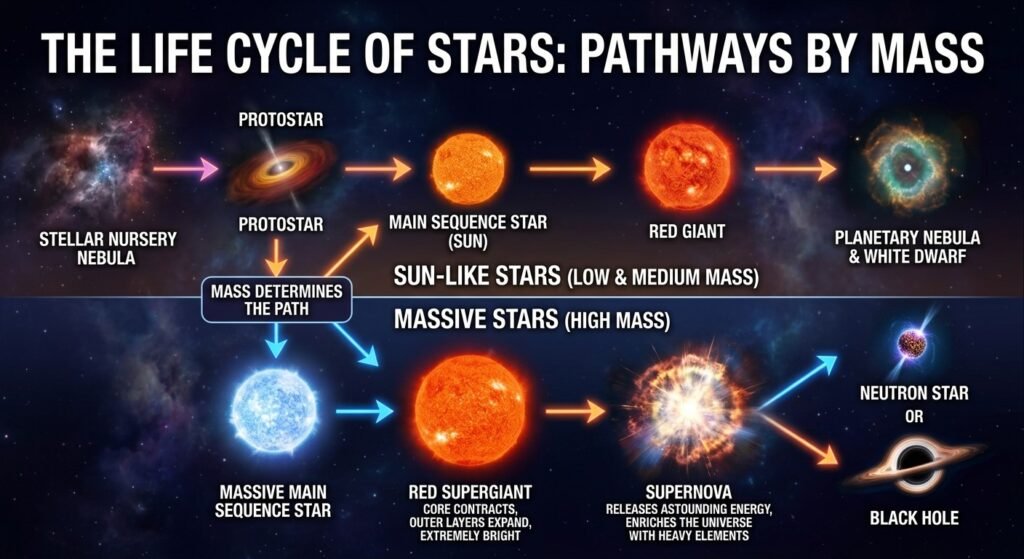
Sun-like star → Red Giant → Planetary Nebula → White Dwarf
1.6.14 Life Cycle of Massive Stars
Massive stars follow a much more dramatic evolutionary path.
Because their cores reach extremely high temperatures and pressures,
they can undergo fusion involving elements heavier than hydrogen and
helium during advanced stages.
1.6.15 Red Supergiant
A very massive star can expand into a
red supergiant during an advanced stage of its
evolution.
These stars are enormous and can have extremely large radii compared
with the Sun. Their cores become hot enough for more advanced nuclear
fusion processes.
1.6.16 Supernova
A supernova is a tremendously energetic stellar
explosion. Certain massive stars can end their lives in a
core-collapse supernova.
During a supernova, enormous amounts of energy and material can be
released into space. These events play an important role in enriching
the Universe with heavier elements.
💥 Supernova — CSS Concept
A massive star may end its life in a powerful explosion known as
a supernova, leaving behind a compact remnant.
1.6.17 Neutron Star
Some massive stars leave behind an extremely dense remnant known as
a neutron star.
A neutron star is composed predominantly of densely packed nuclear
matter and can contain a mass comparable to that of the Sun within
a sphere only about the size of a city.
🔵 Key Fact
Neutron stars are among the densest known stellar remnants.
1.6.18 Black Hole
Under certain conditions, the collapsed core of a very massive star
can form a black hole.
A black hole is a region of spacetime where gravity is so strong that
beyond its event horizon, nothing—including light—can escape.
🕳️ Black Hole
The boundary surrounding a black hole beyond which escape is
impossible is called the event horizon.
📊 Low-Mass and Massive Stars — Comparison
| Feature | Sun-Like / Lower-Mass Star | Massive Star |
|---|---|---|
| Typical Evolution | Main sequence → Red giant | Main sequence → Red supergiant |
| Final Major Event | Outer layers expelled | Supernova may occur |
| Remnant | White dwarf | Neutron star or black hole |
| Lifetime | Generally longer | Generally shorter |
1.6.19 The Sun’s Life Cycle
The Sun is currently a main-sequence star. It formed
approximately 4.6 billion years ago and is expected to remain in the
main-sequence stage for several billion more years.
Eventually, the Sun will leave the main sequence and expand into a
red giant. It will later shed its outer layers and end as a
white dwarf.
☀️ Sun’s Simplified Life Cycle
Nebula → Protostar → Main Sequence → Red Giant →
Planetary Nebula → White Dwarf
1.6.20 Stellar Remnants
The final compact object left behind after a star’s active life is
called a stellar remnant.
⚪ White Dwarf
Remnant of a Sun-like star after its outer layers are expelled.
🔵 Neutron Star
Extremely dense remnant of certain massive stars.
⚫ Black Hole
Can form from the collapse of the core of a sufficiently massive star.
🌟 Complete Stellar Life Cycle — At a Glance
Nebula→Protostar→Main Sequence
☀️ Sun-Like Star
Red Giant → Planetary Nebula → White Dwarf
💥 Massive Star
Red Supergiant → Supernova → Neutron Star / Black Hole
📚 Important Terms
A region where gravity is so strong that nothing can escape from inside its event horizon.
📝 CSS Exam Focus
These concepts are especially important for objective questions,
conceptual questions and quick revision:
- Stars are massive objects held together by gravity.
- Stars are composed mainly of hydrogen and helium.
- Stars are born in clouds of gas and dust called nebulae.
- A protostar is an early stage of stellar development.
- The main sequence is the major stable stage of a star’s life.
- Nuclear fusion converts hydrogen into helium in Sun-like main-sequence stars.
- Stellar mass strongly influences stellar evolution.
- Sun-like stars eventually become red giants.
- A Sun-like star ultimately leaves behind a white dwarf.
- Massive stars can become red supergiants.
- Massive stars may end their lives in supernova explosions.
- Some massive stellar remnants become neutron stars.
- Under certain conditions, massive stellar remnants can become black holes.
- The Sun is currently a main-sequence star.
⚡ Quick Revision
Birthplace
Nebula
Early Stage
Protostar
Stable Stage
Main Sequence
Sun-like Star
Red Giant → White Dwarf
Massive Star
Red Supergiant → Supernova
Possible Remnants
White Dwarf / Neutron Star / Black Hole
🧠 Check Your Knowledge
- What is a star?
- What are the main elements found in stars?
- Where are stars born?
- What is a protostar?
- What happens during the main-sequence stage?
- What is nuclear fusion?
- Why is stellar mass important?
- What happens to a Sun-like star after its main-sequence stage?
- What is a planetary nebula?
- What is a white dwarf?
- What is a supernova?
- What is a neutron star?
- Under what conditions can a black hole form from a massive star?
- What stage of its life is the Sun currently in?
🚀 CSS GSA One-Liners
- Birthplace of stars: Nebula.
- Young developing star: Protostar.
- Stable stellar stage: Main sequence.
- Main fusion in Sun-like stars: Hydrogen into helium.
- Sun’s current stage: Main sequence.
- Sun’s future: Red giant followed by white dwarf.
- Massive star’s explosive death: Supernova.
- Dense stellar remnant: Neutron star.
- Extreme gravitational remnant: Black hole.
- Main factor determining stellar evolution: Mass.
📝 CSS-Style Practice MCQs
1. Stars are formed primarily in:
A. Black holes
B. Nebulae
C. White dwarfs
D. Asteroids
2. During the main-sequence stage, Sun-like stars primarily fuse:
A. Helium into hydrogen
B. Hydrogen into helium
C. Oxygen into hydrogen
D. Carbon into oxygen
3. The current evolutionary stage of the Sun is:
A. Red giant
B. White dwarf
C. Main sequence
D. Supernova
4. The final remnant of a Sun-like star is expected to be a:
A. Black hole
B. White dwarf
C. Neutron star
D. Supernova
5. A powerful explosion associated with the death of certain massive stars is called:
A. Nebula
B. Protostar
C. Supernova
D. White dwarf
🌟 Key Takeaway
A star’s life begins in a cloud of gas and dust, progresses through
stages of stellar evolution, and ultimately ends in a form largely
determined by its mass. Understanding this relationship is essential
for mastering questions about stars in General Science and Ability.
🔭 Further Reading
For additional astronomy information and educational resources,
consult NASA’s official resources on stars and stellar evolution.
|
1.6 Stars and Their Life Cycle
From stellar nurseries to white dwarfs, neutron stars and black holes,
the life of a star is one of the most fascinating processes in the
Universe.