1.1 Introduction to the Universe

›
Chapter 1: The Universe and Its Structure
›
Lesson 1: Introduction to the Universe
🎯 Learning Objectives
After completing this lesson, you should be able to:
- Define the Universe in scientific terms.
- Understand the enormous scale of the Universe.
- Differentiate between the Universe, galaxy, star and Solar System.
- Identify the major structures and objects found in the Universe.
- Understand the position of our Solar System within the Milky Way Galaxy.
- Understand why astronomers use special units to measure astronomical distances.
- Recognize important concepts frequently tested in CSS GSA.
1.1.1 What Is the Universe?
The Universe refers to the totality of everything that exists. It includes space, time, matter, energy and the enormous variety of structures and objects found throughout cosmic space.
These include galaxies, stars, planets, moons, gas, dust, nebulae, black holes and other astronomical structures.
Earth is only a very small part of this vast cosmic system. Our planet is located in the Solar System, which itself is located inside the Milky Way Galaxy.
The Universe is the totality of space, time, matter and energy, together with all the astronomical structures and phenomena within it.
1.1.2 The Vastness of the Universe
One of the most remarkable characteristics of the Universe is its enormous scale. The distances between astronomical objects can be so large that ordinary units such as meters and kilometers become inconvenient.
Astronomers therefore use specialized units for describing astronomical distances. Two important units that CSS candidates should know are the light-year and the astronomical unit (AU).
The complete cosmic system containing space, time, matter, energy and astronomical structures.
A huge gravitationally bound system containing stars, gas, dust and other astronomical objects.
A massive astronomical object that produces energy and emits electromagnetic radiation.
1.1.3 Understanding the Cosmic Hierarchy
A useful way to understand our place in the Universe is to move from our home planet toward increasingly larger structures.
Remember this sequence:
Earth → Solar System → Milky Way Galaxy → Universe
1.1.4 Major Components of the Universe
The Universe contains a wide variety of astronomical objects. Some of the most important objects for CSS GSA preparation are summarized below.
| Object / Structure | Basic Description | CSS Relevance |
|---|---|---|
| Galaxies | Huge gravitationally bound systems containing stars, gas and dust. | High |
| Stars | Massive astronomical objects that generate and emit energy. | High |
| Planets | Celestial bodies that orbit stars and do not produce their own visible light like stars. | High |
| Moons | Natural satellites that orbit planets or other bodies. | Medium |
| Asteroids | Rocky objects that orbit the Sun. | Medium |
| Comets | Icy bodies that may develop visible tails when approaching the Sun. | Medium |
1.1.5 What Is a Galaxy?
A galaxy is a vast gravitationally bound system containing stars, gas, dust and other astronomical objects.
Galaxies can have different shapes and structures. Common broad classifications include spiral, elliptical and irregular galaxies.
Spiral Galaxy
Has a flattened structure with spiral arms. The Milky Way is a spiral galaxy.
Elliptical Galaxy
Generally has an elliptical or rounded appearance.
Irregular Galaxy
Does not have a regular spiral or elliptical structure.
1.1.6 The Milky Way Galaxy
Our Solar System is located within the Milky Way Galaxy. The Milky Way is a spiral galaxy containing enormous numbers of stars along with gas and dust.
Because we live inside the Milky Way, we cannot see its complete structure from an outside viewpoint. Astronomers use observations at different wavelengths and scientific models to investigate its structure.
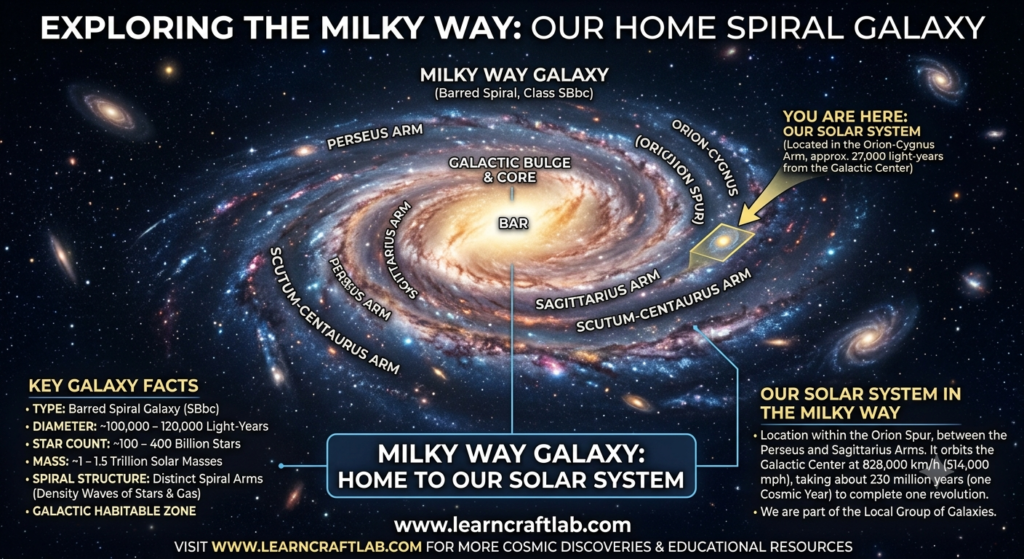
Our Solar System is located in the Milky Way Galaxy.
1.1.7 Our Solar System
The Solar System is the planetary system centered on the Sun. It includes the Sun and the celestial bodies gravitationally associated with it, including the eight planets and smaller bodies.
The eight planets are: Mercury, Venus, Earth, Mars, Jupiter, Saturn, Uranus and Neptune.
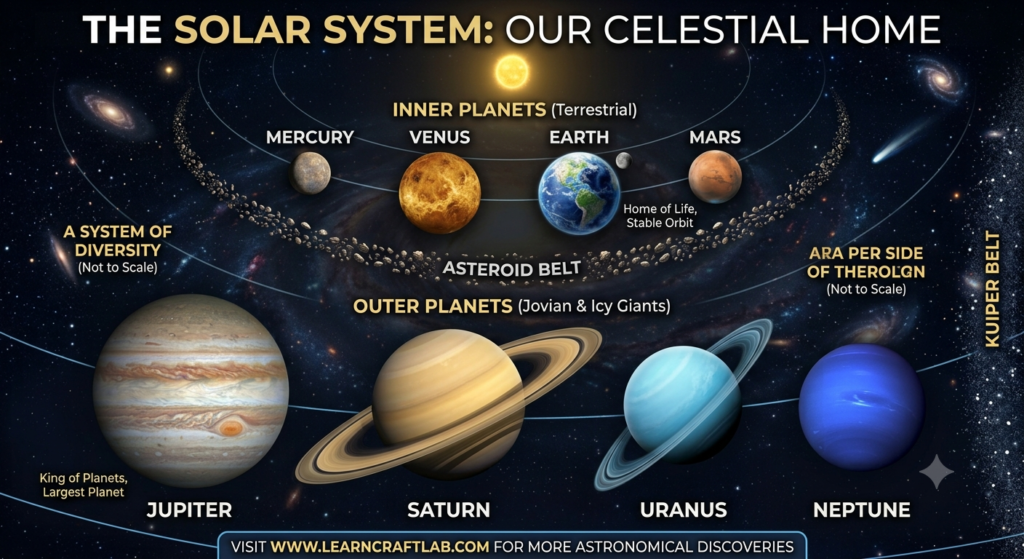
Important:
Educational Solar System diagrams are usually not drawn to scale. The distances between planets are much greater than can conveniently be shown in a single illustration.
1.1.8 Stars
Stars are enormous astronomical objects composed mainly of extremely hot matter in the form of plasma. They emit electromagnetic radiation, including visible light.
The Sun is the star at the center of our Solar System. Its energy drives many important processes on Earth and is essential for life as we know it.
The Sun
The Sun is the star at the center of our Solar System.
Stars
Stars produce and emit energy through processes occurring within their interiors.
1.1.9 Matter and Energy in the Universe
The Universe contains matter and energy in many different forms. Matter includes stars, planets, gas, dust and other physical structures.
Energy is present in different forms, including electromagnetic radiation emitted by astronomical objects.
Matter
- Stars
- Planets
- Gas
- Dust
- Other cosmic objects
Energy
- Electromagnetic radiation
- Light
- Heat
- Radiation from cosmic objects
1.1.10 Why Is Light Important in Astronomy?
Astronomers cannot physically visit most stars and galaxies. Instead, they gather information by observing electromagnetic radiation arriving from astronomical objects.
By studying this radiation, scientists can obtain information about various properties of distant objects, including their temperature, composition and motion.
🔭 Astronomy Through Light
1.1.11 Important Terms
| Term | Meaning |
|---|---|
| Universe | The totality of space, time, matter, energy and cosmic structures. |
| Galaxy | A huge gravitationally bound system containing stars, gas and dust. |
| Star | A massive astronomical object that emits energy and radiation. |
| Solar System | The Sun and the celestial bodies gravitationally associated with it. |
| Light-Year | A unit of distance based on how far light travels in one year. |
| Astronomical Unit (AU) | A unit commonly used to describe distances within planetary systems. |
📝 CSS Exam Focus
For CSS General Science and Ability preparation, pay special attention to the relationships between the following concepts:
- Milky Way: Our Galaxy.
- Sun: The star at the center of our Solar System.
- Galaxy: A huge gravitationally bound system of stars, gas and dust.
- Light-year: A unit used to express astronomical distance.
- AU: An astronomical distance unit commonly used within planetary systems.
⚡ Quick Revision
Universe
The complete cosmic system.
Galaxy
A huge gravitationally bound cosmic system.
Milky Way
The galaxy containing our Solar System.
Sun
The star at the center of our Solar System.
🧠 Check Your Knowledge
- What is meant by the Universe?
- What are the major components of the Universe?
- What is a galaxy?
- Which galaxy contains our Solar System?
- What is a star?
- What is the Solar System?
- What is the Sun?
- Why are special units required to measure astronomical distances?
- What is a light-year?
- What is an astronomical unit?
- Why is electromagnetic radiation important in astronomy?
🚀 CSS GSA One-Liners
- The Universe contains all known space, time, matter and energy.
- Our Solar System is located in the Milky Way Galaxy.
- The Milky Way is a spiral galaxy.
- The Sun is a star.
- Galaxies are held together by gravity.
- Light-year is a unit of astronomical distance.
- AU is commonly used for distances within planetary systems.
- Astronomers study electromagnetic radiation to learn about distant objects.
1.2 Galaxies
Explore galaxy types, structure, the Milky Way, galaxy groups and important CSS examination concepts.