
General Science and Ability CSS Course 2026 2 Sections12 LessonsLifetime
1.5 The Milky Way Galaxy
🌌 Introduction
When we look at the night sky from a dark location, we may see a
faint, cloudy band of light stretching across the sky. This beautiful
band is the visible appearance of our home galaxy, the
Milky Way Galaxy.
The Milky Way is a vast gravitationally bound system containing
enormous numbers of stars along with gas, dust and other cosmic
material. Our Sun, Earth and entire Solar System
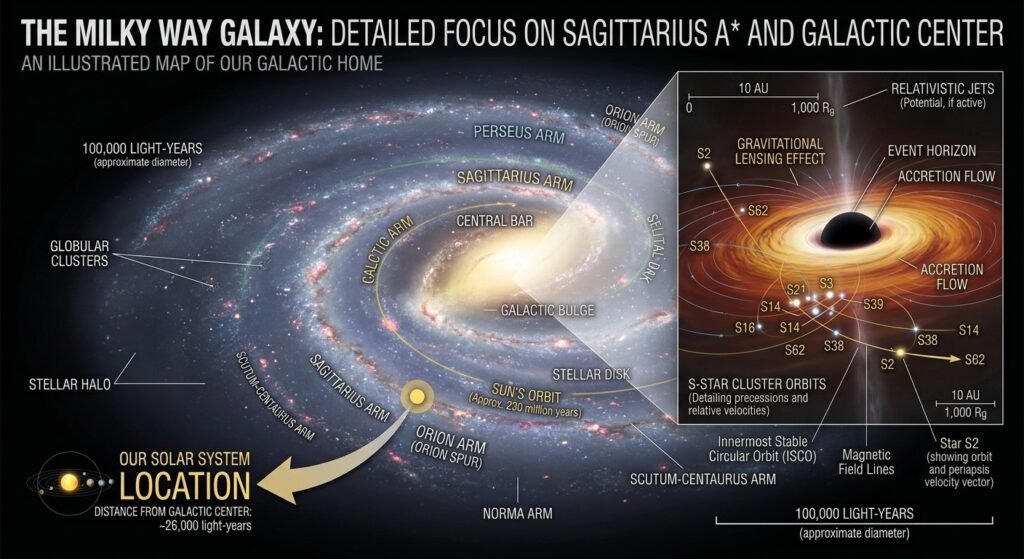
are located inside this galaxy.
NASA describes the Milky Way as a spiral galaxy whose stellar disk
spans more than 100,000 light-years. Our Solar System lies along one
of its spiral structures, commonly identified as the
Orion Arm or Orion Spur.

🎯 Learning Objectives
After completing this lesson, you should be able to:
- Define the Milky Way Galaxy.
- Identify the type of galaxy to which the Milky Way belongs.
- Describe the major structural components of the Milky Way.
- Explain the concept of the galactic disk and central bulge.
- Understand the role of spiral arms.
- Identify the location of our Solar System within the Milky Way.
- Explain the importance of Sagittarius A*.
- Understand the scale of the Milky Way.
- Understand the motion of the Solar System around the galactic center.
- Recall important Milky Way facts for CSS GSA questions.
1.5.1 What Is the Milky Way Galaxy?
The Milky Way Galaxy is the galaxy that contains our
Solar System. It is a huge gravitationally bound system composed of
stars, gas, dust and other astronomical structures.
The Milky Way belongs to the broad class of
spiral galaxies. Its stars, gas and dust are
distributed mainly within a flattened disk, while a denser central
region forms a galactic bulge.
📌 CSS Key Definition
The Milky Way Galaxy is the spiral galaxy that contains our
Solar System.
1.5.2 Type of the Milky Way
The Milky Way is classified as a
barred spiral galaxy. It has a flattened disk,
spiral structures and a central region containing a bar-like
arrangement of stars.
NASA identifies the Milky Way as a spiral galaxy with prominent
spiral structures extending from its central region.
🌌 Galaxy Type
Spiral Galaxy
⭐ Central Structure
Central bulge and bar
🌀 Spiral Arms
Contain stars, gas and dust
1.5.3 Structure of the Milky Way
The Milky Way has a complex structure. For CSS GSA preparation,
its major structural components can be understood as the
galactic disk, central bulge, spiral arms and halo.
1. Galactic Disk
A broad, flattened region containing many stars, gas and dust.
The Solar System lies within this disk.
2. Central Bulge
A dense, roughly spherical central region containing a high
concentration of stars.
3. Spiral Arms
Large spiral structures containing stars, gas, dust and
important star-forming regions.
4. Galactic Halo
A more extended region surrounding the main disk and containing
old stars, globular clusters and dark matter.
1.5.4 The Galactic Disk
The galactic disk is the flattened portion of the
Milky Way where a large population of stars, gas and cosmic dust is
concentrated.
The disk contains the spiral structures that give the Milky Way its
characteristic appearance when viewed from above.
Remember:
Our Solar System is located within the Milky Way’s disk.
1.5.5 The Galactic Bulge
At the center of the Milky Way is a dense region known as the
galactic bulge.
The bulge contains a very large concentration of stars. Compared
with our region of the galaxy, the central region is much more
densely populated with stars.
NASA observations show that the inner region of the Milky Way
contains an extremely dense stellar environment surrounding its
central black hole.
1.5.6 Spiral Arms of the Milky Way
The Milky Way’s disk contains large-scale spiral structures called
spiral arms. These structures contain stars, gas,
dust and regions where new stars can form.
The exact structure and positions of the Milky Way’s spiral arms
continue to be refined as astronomers obtain better observations.
🌀 Spiral Structure
Extends outward from the central region.
⭐ Stars
Large populations of stars are distributed through the arms.
🌫️ Gas & Dust
Important material for star formation.
1.5.7 The Orion Arm / Orion Spur
Our Solar System is located in a smaller spiral structure commonly
called the Orion Arm or Orion Spur.
The Sun is therefore not located at the center of the Milky Way.
It lies within the galactic disk, considerably away from the
galactic center.
📍 Our Cosmic Address
1.5.8 Location of the Solar System
The Solar System is located inside the Milky Way’s disk, within the
Orion Spur. NASA estimates that the Solar System is roughly
26,000 light-years from the galactic center.
This location is important because it places our Solar System well
away from the extremely dense central region of the galaxy.
⭐ CSS Fact
The Sun is not at the center of the Milky Way.
Our Solar System lies within the Orion Arm/Spur of the galactic
disk.
1.5.9 Size of the Milky Way
The Milky Way is enormous. NASA estimates that its main stellar disk
spans more than 100,000 light-years.
NASA also gives an estimated population of roughly
100 to 400 billion stars, illustrating the enormous
scale of our galaxy.
Approximate span of the stellar disk
Approximate number of stars
1.5.10 The Center of the Milky Way
The center of the Milky Way is a highly concentrated region containing
enormous numbers of stars and a supermassive black hole.
This black hole is known as
Sagittarius A*, commonly pronounced
“Sagittarius A-star.”
🕳️ Sagittarius A*
Sagittarius A* is the supermassive black hole at the center of
the Milky Way.
Approximate Mass:
about 4 million times the mass of the Sun.
1.5.11 Motion of the Milky Way and Solar System
The Milky Way is not a stationary structure. Stars and other
components of the galaxy participate in large-scale motion around
the galactic center.
Our Sun also moves around the center of the Milky Way. NASA estimates
that one complete orbit takes roughly 230–240 million
years, depending on the measurement and model used.
💡 Remember
The Sun orbits the center of the Milky Way, while the planets
simultaneously orbit the Sun.
1.5.12 Stars, Gas and Dust
The Milky Way is not made up of stars alone. It also contains large
quantities of gas and cosmic dust.
Clouds of gas and dust are particularly important because they provide
material from which new stars can form. Young stars are therefore
closely associated with some regions of the galactic disk and spiral
structures.
Stars
Main luminous objects
Gas
Important material for star formation
Dust
Interstellar solid particles
1.5.13 The Milky Way and Dark Matter
The visible stars, gas and dust do not account for all of the mass
associated with the Milky Way. Astronomers infer the presence of
dark matter from its gravitational effects.
Dark matter does not emit or reflect light in the way ordinary visible
matter does, making it difficult to observe directly. Its gravitational
influence, however, plays an important role in understanding the
structure and motion of galaxies.
1.5.14 The Milky Way and the Local Group
The Milky Way is not isolated. It belongs to a collection of galaxies
known as the Local Group.
The Local Group contains the Milky Way, the Andromeda Galaxy and many
smaller galaxies, including dwarf galaxies.
🌌 Cosmic Neighborhood
Milky Way → Local Group → Larger Cosmic Structures
1.5.15 Milky Way and Andromeda Galaxy
The Andromeda Galaxy is the nearest large galaxy to
the Milky Way. Both galaxies are members of the Local Group.
Their gravitational interaction is an important subject in astronomy
and provides scientists with an opportunity to study the long-term
evolution of large galaxies.
📊 Milky Way — Quick Facts
| Feature | Key Information |
|---|---|
| Name | Milky Way Galaxy |
| Type | Spiral / barred spiral galaxy |
| Our Location | Orion Arm / Orion Spur |
| Solar System Distance from Center | Approximately 26,000 light-years |
| Approximate Disk Size | More than 100,000 light-years across |
| Estimated Stars | Roughly 100–400 billion |
| Central Black Hole | Sagittarius A* |
| Local Group | Member of the Local Group |
📝 CSS Exam Focus
The following facts are particularly useful for objective questions
and short conceptual questions in General Science and Ability:
- The Milky Way is our home galaxy.
- The Milky Way is a spiral galaxy.
- It contains the Solar System.
- The Solar System is located in the Orion Arm/Orion Spur.
- The Milky Way has a central bulge and a flattened disk.
- Sagittarius A* is the supermassive black hole at the galactic center.
- The Sun is not located at the center of the Milky Way.
- The Milky Way is more than 100,000 light-years across in its stellar disk.
- The Milky Way belongs to the Local Group.
- The Andromeda Galaxy is the nearest large galaxy to the Milky Way.
⚡ Quick Revision
Milky Way
Our home galaxy.
Galaxy Type
Spiral / barred spiral.
Our Location
Orion Arm / Spur.
Galactic Center
Sagittarius A*.
Solar System
Inside the Milky Way.
Local Group
Our galactic neighborhood.
🧠 Check Your Knowledge
- What is the Milky Way Galaxy?
- What type of galaxy is the Milky Way?
- Where is our Solar System located?
- What is the galactic disk?
- What is the galactic bulge?
- What are spiral arms?
- What is the Orion Arm or Orion Spur?
- How far is the Solar System approximately from the center of the Milky Way?
- What is Sagittarius A*?
- What is the Local Group?
- Which large galaxy is the nearest major neighbor of the Milky Way?
🚀 CSS GSA One-Liners
- Milky Way: The galaxy containing our Solar System.
- Galaxy type: Spiral galaxy; commonly described as a barred spiral.
- Solar System location: Orion Arm / Orion Spur.
- Galactic center: Contains Sagittarius A*.
- Sagittarius A*: Supermassive black hole at the center of the Milky Way.
- Solar System distance: Approximately 26,000 light-years from the galactic center.
- Milky Way disk: More than 100,000 light-years across.
- Local Group: The group of galaxies containing the Milky Way.
- Andromeda: The nearest large galactic neighbor of the Milky Way.
📝 CSS-Style Practice MCQs
1. The galaxy containing our Solar System is:
A. Andromeda Galaxy
B. Milky Way Galaxy
C. Whirlpool Galaxy
D. Triangulum Galaxy
2. Sagittarius A* is:
A. A planet
B. A galaxy
C. A supermassive black hole
D. A nebula
3. Our Solar System is located in which part of the Milky Way?
A. Galactic center
B. Orion Arm / Orion Spur
C. Galactic nucleus
D. Andromeda Arm
🔭 Further Reading
For additional astronomical information and visual material, consult
NASA’s educational resources on the Milky Way and galaxies.
NASA Science — Galaxies
|
NASA — Our Galaxy
1.5 The Milky Way Galaxy
From Earth to the Solar System, from the Orion Spur to the Milky Way —
understanding our cosmic address is an essential part of astronomy
and General Science and Ability preparation.